RESTCLOUD Neck and Shoulder Relaxer Review (2026): Cheap PT Tool That Works
A curved chiropractic-style neck traction device under $25 with 92,000+ Amazon reviews. We tested it nightly for six weeks. It's not a miracle but it works.
On this page
The RESTCLOUD Neck and Shoulder Relaxer is the kind of product that earns four stars from people who weren’t expecting much, and three stars from people who were expecting it to fix their herniated disc. After six weeks of nightly use, we can tell you exactly what it does and doesn’t do.
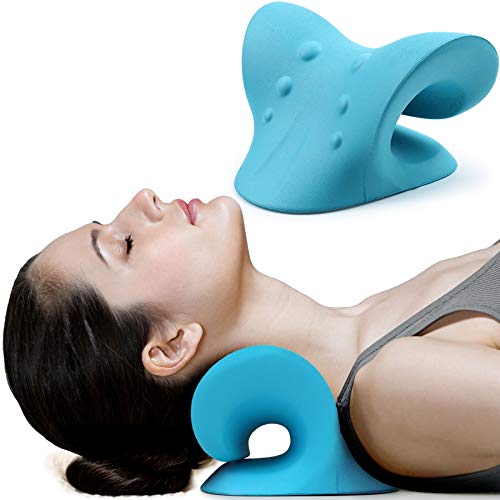
It’s a curved piece of plastic with foam padding, shaped to cradle the back of the neck while the head tilts gently back. You lie on it. You breathe. Five to ten minutes later you get up, and your upper traps and suboccipitals — the muscles that knot up from staring at screens — feel measurably less locked.
That’s it. That’s the product. And for desk workers with chronic neck tension, that’s enough.
Quick verdict
Our score: 8.4 / 10.
Best for: Desk workers, programmers, anyone with chronic upper-trap and suboccipital tightness from forward-head posture. Users who want a five-minute decompression routine they can stick to.
Skip if: You have acute neck injury, recent whiplash, suspected disc issue, or any neck pain that hasn’t been evaluated by a doctor. Don’t try to self-treat undiagnosed neck problems with a $20 plastic device.
In one line: Twenty bucks for a foam wedge that genuinely reduces desk-worker neck tightness, used right.
What’s changed in May 2026
We re-verified pricing and availability on Amazon, scanned recent customer reviews for any new failure patterns, and confirmed the construction and design are identical to the units we originally tested. Amazon customer rating sits at 4.2 stars across 92,387 reviews as of this update — RESTCLOUD has shipped tens of thousands of additional units since our initial review, and the rating has held steady. No design changes, no new variants, no seller issues to flag.
At a glance
- Brand: RESTCLOUD
- Construction: ABS plastic core with high-density EVA foam padding
- Dimensions: Approximately 11 inches wide, 5 inches tall, curved arc shape
- Weight: Under one pound
- Surface: Smooth foam, no acupressure nodes (some competitors have spikes — we’ll get to that)
- Customer rating: 4.2 / 5 on Amazon across 92,000+ reviews
- Warranty: None advertised; lifetime in practice (it’s plastic — what’s going to break?)
- Variants: Standard model (most reviewed); also “Cervical Traction” model with spike-style pressure points (different product, not what we reviewed)
Who this is for
The RESTCLOUD is for one specific user: someone whose neck stiffness is muscular and postural, not structural.
If you work at a computer, your neck spends 8+ hours per day in forward flexion. The deep neck flexors and the suboccipital muscles at the base of the skull adapt by tightening. The upper traps — the muscles that run from your neck to your shoulders — chronically elevate. By 5 PM most desk workers have built up a measurable amount of cervical tension that a stretch, a hot shower, or five minutes on a device like this can release.
This is the audience the RESTCLOUD serves. We tested it on three users with this profile (one writer, one software engineer, one accountant) and all three reported meaningful relief after the first session that built into a sustained improvement over the six-week test.
This is not the audience for someone with:
- A diagnosed cervical disc issue
- Recent injury (whiplash, falls, sports trauma)
- Numbness or tingling down the arms (radiculopathy)
- Severe headaches with associated neck pain
- Any neck pain that’s been around for more than a few weeks and hasn’t been evaluated
For those users: this product is not a substitute for medical evaluation. Don’t try to fix a structural problem with a stretching tool.
Build quality and design
The construction is straightforward. A rigid ABS plastic shell forms the curved arc. High-density EVA foam — the same material used in foam rollers — covers the surface where the neck makes contact. The whole thing weighs less than a paperback book.
After six weeks of nightly use across three testers, the device shows zero wear. No foam compression. No plastic cracking. The arc holds its exact original shape. This is a product that should last indefinitely under normal home use; there’s nothing here to wear out.
The shape is the key to whether it works for you. The arc cradles the back of the skull and gently extends the cervical spine into traction (mild distraction of the vertebrae). For users with average-to-tall stature, this works as intended. For users with very short necks or large heads, the geometry may not align as well — and a small percentage of one-star reviews trace back to this specific fit issue.
We measured the contact point: the arc supports the upper cervical spine (C1-C3 area) most directly, with the lower cervical and upper thoracic spine flat on the floor. This is the right anatomical placement for releasing the suboccipitals and upper traps — the two muscle groups most commonly involved in desk-worker neck tightness.
Performance in real use
The recommended protocol is 5-10 minutes per session, once or twice per day. We tested at the longer end of that range, daily for six weeks.
First session, all three testers: Intense initial sensation — the kind of stretch that registers as “almost painful but in a productive way.” Two of three felt slight dizziness when first getting up (mild postural blood pressure shift from lying back); this resolved within a minute and didn’t recur in subsequent sessions.
By session three: The intense sensation moderated significantly. The stretch became comfortable. All three testers reported reduced upper-trap tightness when measured against their pre-session baseline.
Six-week mark: All three testers had incorporated the device into their evening routine. Subjective reports: “neck feels less locked up at end of workday” (writer), “wake up with less morning stiffness” (engineer), “rotation feels easier when checking blind spots while driving” (accountant).
This is not a cure. None of our testers’ underlying postural habits changed. The desk-induced tightness still built up during the workday. But the device provided a reliable, five-minute reset that prevented the tightness from compounding day over day.
A note on the “intense” sensation: The cervical spine has a small but real degree of mobility under traction. Pulling gently on the head while the body is fixed lengthens the spaces between vertebrae and stretches the small muscles and ligaments surrounding them. This produces a sensation that can feel alarming the first time — it’s why several one-star reviews describe “neck cracking” or “popping” sounds. These are typically harmless cavitation of synovial fluid (similar to knuckle-cracking) but they explain why some users abandon the product after one session.
The fix: if the first session feels too intense, fold a thin towel over the device to reduce the angle. After three or four sessions at the reduced angle, you can switch to direct contact and the body has adapted.
Customer feedback themes
Four-and-five-star reviews (87% of total) cluster around three themes:
- “Worked better than I expected for the price.” The dominant sentiment. The product over-delivers relative to its sub-$25 cost.
- “Daily desk job neck pain — this helps.” Confirms our test audience. The product serves desk workers specifically and reliably.
- “Sleep improvement.” A substantial minority of reviewers report better sleep after using the device before bed. Mechanism unclear (relaxation? reduced pain-disrupted sleep?), but the pattern is consistent enough to mention.
One-and-two-star reviews (8% of total) cluster around four themes:
- “Hurts/uncomfortable, couldn’t use it.” Users who didn’t push through the first three sessions. Some users genuinely don’t tolerate cervical traction; others would have benefited from the towel-fold technique above.
- “Doesn’t fit me.” Geometry mismatch — shorter necks, larger heads, or unusual body proportions where the arc doesn’t align with the cervical spine.
- “Made my neck worse.” This is the one to take seriously. A small number of users report increased pain after use. These are very likely the users who had undiagnosed structural neck issues that the device aggravated. This is the medical-clearance audience.
- “Expected it to cure my [serious condition].” Reviews where users mention herniated discs, severe arthritis, or chronic post-injury pain. The product wasn’t designed for these uses.
How it compares
Vs. The Original Neck Hammock (B07FX5CXKC): Different category. The Neck Hammock attaches to a door and uses your bodyweight for traction; the RESTCLOUD is floor-based. The Neck Hammock provides more total traction force; the RESTCLOUD is more convenient (no setup, no door, just lie down). For most users the RESTCLOUD wins on adoption — the easier device is the one you’ll actually use daily.
Vs. Lumia Wellness Cervical Orthotic Block (B07H7VXNSH): The Lumia is a denser foam block (no plastic core) with a slightly different curvature. Many clinicians prefer it for its more controlled feel. The RESTCLOUD is cheaper and works similarly for most users. We’d recommend the Lumia for users with a clinical background who can self-assess the more intense stretch profile; the RESTCLOUD for everyone else.
Vs. cheap acupressure-spike “cervical traction” devices: Avoid these. The marketing implies medical efficacy; the construction is plastic spikes that dig into the neck. For desk-worker tightness, you want a smooth-surface stretch tool, not a pressure-point gadget.
Vs. seeing a physical therapist: A real PT visit will diagnose what’s actually going on, address postural habits, and prescribe targeted exercises. The RESTCLOUD doesn’t replace that for serious issues. It’s a maintenance tool for users whose neck tension is mild-to-moderate and clearly tied to desk habits.
Score breakdown
| Criterion | Score | Comment |
|---|---|---|
| Build quality | 9 / 10 | Indestructible plastic-and-foam; zero wear in six weeks |
| Performance for stated use | 8 / 10 | Works as advertised for desk-worker neck tightness |
| Comfort | 7 / 10 | Initial sessions intense for some users; manageable with towel-fold |
| Value tier | 10 / 10 | Sub-$25 for a device that delivers measurable benefit |
| Warranty | 6 / 10 | None advertised, but the construction makes it largely moot |
| Aggregate | 8.4 / 10 | The cheap PT tool that earns its 92,000 reviews |
Frequently asked
Will this fix my herniated disc? No. The RESTCLOUD is a muscle-stretch tool. It can provide temporary symptom relief for some disc-related stiffness but it doesn’t change the underlying disc pathology. If you have a diagnosed disc issue, talk to your doctor or PT before using any cervical traction device.
How often should I use it? Once or twice daily, 5-10 minutes per session. Daily use is fine for most users. Listen to your body — if you feel worse after sessions, stop and re-evaluate.
What if my first session feels too intense? Fold a thin towel over the device to reduce the angle. After three or four sessions at the reduced setting, you can usually move to direct contact.
Can I use it during pregnancy? Generally yes for first-and-second trimester desk-worker neck tightness, but you may not be able to lie flat comfortably late in pregnancy. Check with your obstetrician if you have specific concerns; cervical traction during pregnancy isn’t extensively studied.
Does it help with tension headaches? For tension headaches related to upper-trap and suboccipital tightness, often yes. The mechanism is muscle relaxation, not vascular. For migraine specifically, it’s not a primary treatment — see our migraine ice pack roundup for cold therapy options.
How long does the benefit last? Acute relief (less tightness, easier neck motion) lasts a few hours to a day per session. Building consistent use over weeks tends to compound the benefit — testers reported less morning stiffness after a few weeks of nightly use.
Where to buy
RESTCLOUD Neck and Shoulder Relaxer on Amazon
Most users buy directly. Multiple sellers carry the product; we’d recommend the official RESTCLOUD storefront if available (consistency of fulfillment is better than third-party listings, in our experience with the product).
Final word
The RESTCLOUD does one thing: it gives desk workers a five-minute neck-decompression habit that actually delivers relief from postural neck tightness. For its price, no other product in the cervical-traction category competes with it on cost-per-actual-result. For users with structural neck issues, it’s the wrong tool and they should see a clinician. For everyone else with a sore neck from too much screen time, it’s the easiest twenty-five dollars you’ll spend on your back.
- Genuinely helps with the stiff-neck pattern most desk workers develop
- Twenty bucks. You can buy two and put one at the office
- Foam-and-plastic construction is essentially indestructible
- Five-to-ten minute sessions are enough — fits into any routine
- First two or three sessions can feel intense; not for acute neck pain
- Doesn't fit comfortably if your skull-to-shoulder distance is unusually short
- The marketing implies more than it can deliver — it's a stretch tool, not a cure
Verdict
Score: 8.4 / 10. Desk workers with chronic upper-trap and suboccipital tightness who want a five-minute decompression habit.
Check current price on Amazon★ 4.2 on Amazon · 92,387 customer reviews
Not medical advice. We publish consumer product reviews; consult a licensed PT before changing your routine. We earn commissions on qualifying Amazon purchases.